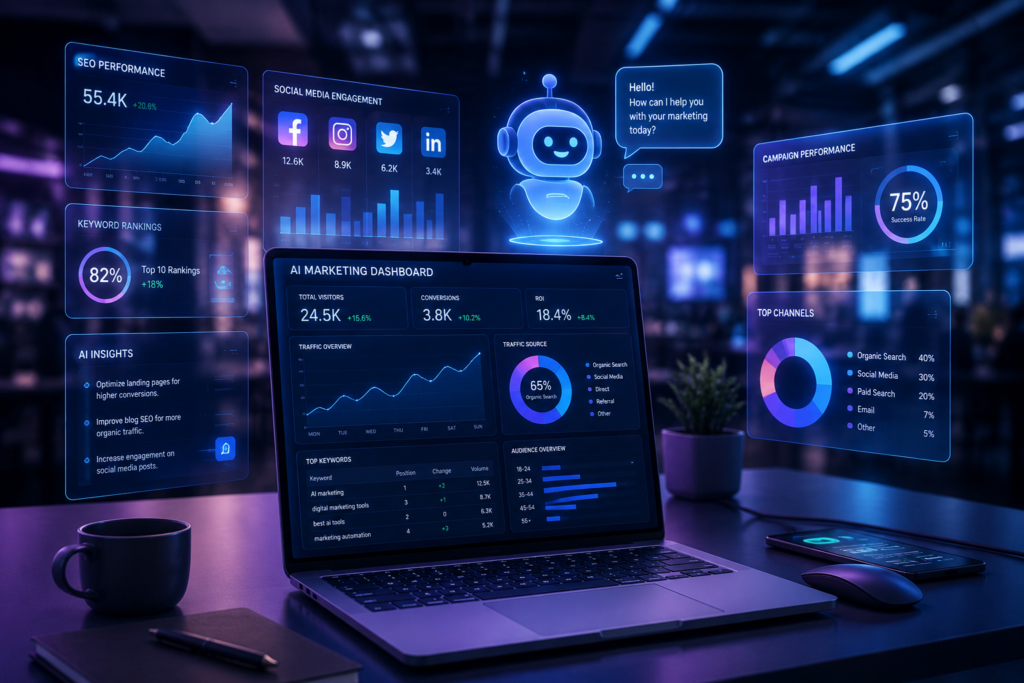
Digital marketing AI

7 Reasons Your Website May Be Invisible in AI Search featured image for digital marketing agency blog on AI search visibility
SEO

7 Reasons Your Website May Be Invisible in AI Search

Search has quietly changed, and it’s a shift every digital marketing agency is watching closely. People are no longer just typing keywords into Google and scrolling through ten blue links. They’re asking ChatGPT, Perplexity, Google’s AI Overviews, and Gemini direct questions and getting direct answers, often without ever clicking through to a website. If your business isn’t showing up in those answers, you’re not just missing a ranking. You’re missing the conversation entirely. Here are seven reasons your website might be invisible in AI search and what that means for the future of your traffic. 1. Your Content Isn’t Structured for Extraction Traditional SEO rewarded long, keyword-stuffed pages built to rank in a list of ten links. AI models work differently. They scan content looking for clear, extractable answers a direct definition, a concise explanation, a well-organized list. If your key information is buried in dense paragraphs, wrapped in marketing fluff, or scattered across multiple pages, AI systems have a harder time pulling it out cleanly. Content that answers a specific question in the first few lines, then expands with supporting detail, is far more likely to get quoted. 2. You’re Missing Structured Data (Schema Markup) AI crawlers and language models lean heavily on structured data to understand what a page is actually about. Schema markup things like FAQ schema, Article schema, Organization schema, and Product schema gives machines a labeled, unambiguous version of your content. Without it, an AI system has to guess at context from raw HTML. Websites that mark up their content clearly are simply easier to trust and easier to cite. 3. Your Brand Has Little to No Presence Beyond Your Website AI models don’t just crawl your site they draw on a much wider pool of information: review platforms, forums like Reddit and Quora, industry publications, news mentions, and social profiles. This is often referred to as your brand’s entity presence. If the only place your business exists online is your own website, AI systems have little external validation that you’re a credible, authoritative source. A strong footprint across third-party platforms signals relevance and trustworthiness in a way a single domain never can. 4. Your Content Doesn’t Directly Answer Real Questions AI search tools are fundamentally question-answering engines. If your content is written around keywords rather than around the actual questions your customers are asking, it’s harder for AI to match your page to a query. This is where formats like FAQs, how-to guides, and comparison content perform well they mirror the conversational, question-based way people now search. Auditing your top pages against real customer questions (and rewriting them to answer those questions directly) can make a significant difference. 5. Your Technical SEO Foundation Has Gaps AI crawlers still need to reach and read your site efficiently, just like traditional search bots. Slow page speeds, broken internal links, poor mobile responsiveness, missing alt text, and blocked crawl paths all limit how much of your content ever gets indexed in the first place by traditional search engines or AI models. If the technical foundation is weak, none of your content strategy matters, because the AI never fully “sees” your site to begin with. 6. You Have Little to No Authoritative Backlink Profile Backlinks still matter arguably more than ever because they act as trust signals for both traditional search engines and AI systems. When high-authority, relevant websites link to your content, it tells AI models that your information has been vetted and valued elsewhere. A thin or low-quality backlink profile makes it harder for your site to be treated as a reliable source worth referencing in an AI-generated answer. 7. Your Content Is Outdated or Inconsistent AI models tend to favor fresh, consistently updated content, especially for topics where accuracy changes over time pricing, statistics, product details, industry trends. If your site hasn’t been updated in months (or years), and your information conflicts with more current sources elsewhere, AI systems are more likely to skip you in favor of a source that’s been recently verified and refreshed. Regularly auditing and updating existing content  not just publishing new pages is one of the most overlooked levers for AI search visibility. Want to know where your website stands in AI search right now? FirstRankology offers a comprehensive website audit that looks beyond traditional SEO covering technical health, content structure, and AI search readiness so you know exactly what’s holding your visibility back and how to fix it.  

Futuristic digital marketing workspace
SEO

Best AI Tools for Digital Marketers in 2026

Artificial Intelligence is transforming the way businesses approach digital marketing. From content creation and SEO optimization to social media management and paid advertising, AI tools are helping marketers save time, improve productivity, and achieve better results. In 2026, AI is no longer just a trend , it has become an essential part of modern marketing strategies. Whether you run a digital marketing agency, manage social media campaigns, or work as a freelancer, using the right AI tools can give you a competitive advantage. In this blog, we’ll explore some of the best AI tools for digital marketers and how they can improve your workflow. Why AI Tools Matter in Digital Marketing AI-powered tools help marketers Automate repetitive tasks Generate content faster Improve SEO performance Create better ad creatives Analyze customer behavior Optimize campaigns in real-time Save time and reduce operational costs According to recent industry reports, more marketers are integrating AI into their daily workflow because it significantly improves productivity and campaign performance. ChatGPT Best for Content Creation & Strategy ChatGPT is one of the most popular AI tools for marketers. It helps generate blog posts, ad copy, email campaigns, captions, and marketing ideas within seconds. Key Features Blog writing assistance Social media captions Ad copy generation Email marketing drafts SEO content ideas Content repurposing Best For Content marketers, agencies, bloggers, and social media managers. Many marketers now use ChatGPT as a daily productivity tool for brainstorming, content planning, and campaign strategy. Jasper AI Best for Marketing Copy Jasper is designed specifically for marketers and businesses that need high-quality marketing copy at scale. Key Features AI-generated blog posts Facebook & Google Ads copy Brand voice customization Landing page writing Product descriptions Best For Agencies and brands managing multiple campaigns. Jasper is widely used for maintaining consistent brand messaging while producing content quickly. Surfer SEO Best for SEO Optimization Surfer SEO helps marketers optimize content for search engines using AI-driven recommendations. Key Features Content optimization Keyword recommendations SERP analysis SEO scoring Internal linking suggestions Best For SEO professionals and bloggers. Surfer SEO analyzes top-ranking pages and provides actionable insights to improve rankings. Canva Best for AI-Powered Design Canva has integrated AI features that make graphic design easier for marketers without advanced design skills. Key Features AI image generation Social media templates Magic Resize Background remover Presentation design Best For Social media marketers and small businesses. AI-powered design tools are helping marketers create professional creatives faster than ever before. HubSpot Best for Marketing Automation HubSpot combines CRM, email marketing, analytics, and automation into one platform. Key Features AI email generation Lead scoring Marketing automation Campaign tracking Customer insights Best For Businesses looking to automate marketing and sales processes.   HubSpot’s AI features help marketers personalize campaigns and improve customer engagement. Midjourney Best for AI Image Generation Midjourney is a powerful AI tool used to create high-quality visuals, ad creatives, and branding graphics. Key Features AI-generated artwork Ad creatives Concept visuals Branding assets Social media graphics Best For Creative agencies and content creators. Visual AI tools are becoming increasingly important in performance marketing and branding campaigns. Perplexity AI  Best for Research Perplexity AI is an AI-powered search and research tool that provides accurate answers with source references. Key Features AI-powered research Source-backed answers Market trend analysis Competitor research Fast information gathering Best For Researchers, SEO experts, and strategists. Many marketers use Perplexity AI for quick research and competitive analysis.   Descript Best for Video Editing Descript simplifies podcast and video editing using AI-powered tools. Key Features AI voice cloning Automatic subtitles Video editing Podcast editing Screen recording Best For Content creators and video marketers. Short-form video content continues to dominate social media, making AI video tools more valuable than ever. How to Choose the Right AI Tool Before selecting an AI tool, consider Your marketing goals Budget Team size Required features Integration options Ease of use The best approach is to combine multiple AI tools for content, SEO, design, automation, and analytics. AI tools are reshaping the digital marketing industry by improving efficiency, creativity, and campaign performance. However, AI works best when combined with human creativity and strategy. Many marketers agree that AI should act as a “co-pilot” rather than a complete replacement for human expertise.

DMCA.com Protection Status
Scroll to Top