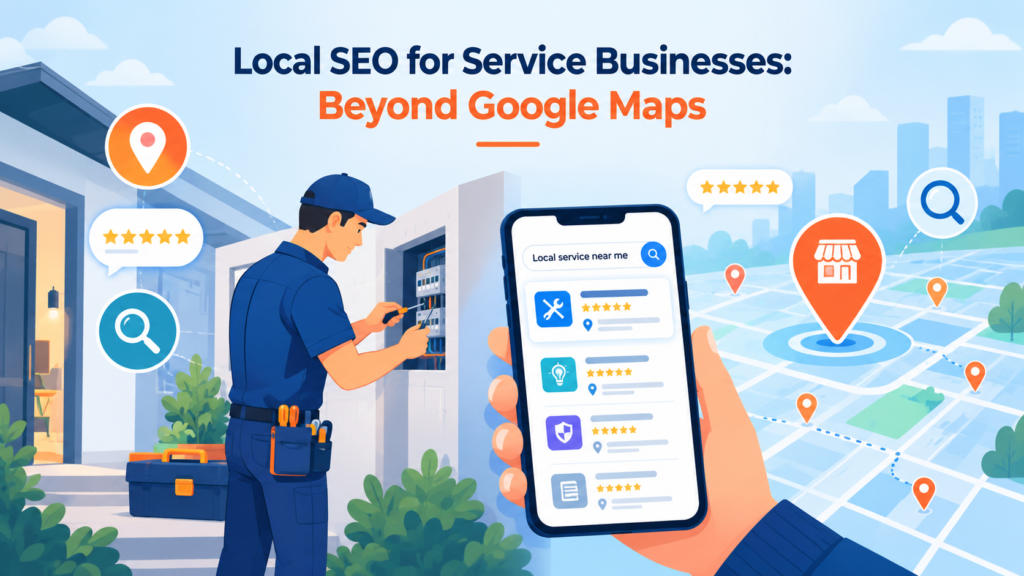
Local SEO for Service Businesses: Beyond Google Maps
If you run a service business a plumber, a clinic, a salon, a law firm, a home renovation company chances are your local SEO strategy begins and ends with your Google Business Profile. And that makes sense. It’s the first thing customers see when they search “near me.” But here’s the problem: everyone else in your category is optimizing for the same map pack too. The businesses that consistently win local customers aren’t just showing up on Google Maps. They’re building visibility everywhere their customers actually look search results, review platforms, social feeds, even voice assistants. This blog breaks down what local SEO looks like once you move past the map pin. Why Google Maps Alone Isn’t Enough Anymore The map pack only shows three listings. If you’re not in the top three for your service and area, most of your competitors are getting the call instead of you. And ranking in the map pack depends on factors far outside your Google Business Profile your website’s authority, your citations, your reviews across platforms, and how consistently your business information appears across the web. Service businesses that rely only on their Google listing are essentially competing for three parking spots while ignoring the rest of the street. Building a Local SEO Strategy That Goes Deeper 1. Location-Specific Landing Pages If you serve multiple neighborhoods, cities, or service areas, a single “Contact Us” page won’t cut it. Dedicated landing pages for each service area with unique content, local landmarks, and area-specific customer stories — help you rank for searches like “electrician in [area]” instead of competing only on your homepage. 2. Citation Consistency Across the Web Your business name, address, and phone number (NAP) need to match exactly across directories like Justdial, Sulekha, Yelp, industry-specific listing sites, and even your social profiles. Inconsistent citations confuse search engines and quietly erode your local rankings, even if your Google profile looks perfect. 3. Review Strategy Beyond Google Reviews on Google matter, but so do reviews on Facebook, industry-specific platforms, and even service marketplaces. A steady, natural flow of reviews across multiple platforms signals trust to both search engines and potential customers who are comparing you against competitors. 4. Local Content That Answers Real Questions Service businesses often skip content marketing because they think it’s only for ecommerce or SaaS. In reality, blog posts answering questions like “How much does AC repair cost in [city]?” or “What to expect during your first physiotherapy session” build topical authority and capture searches happening before someone is ready to call. 5. Local Link Building Getting mentioned and linked to by local news sites, community blogs, business associations, and local sponsorships builds the kind of domain authority that map-pack rankings depend on. These links tell Google your business is a genuine, active part of the local community not just a listing. 6. Structured Data and Schema Markup LocalBusiness schema, service schema, and FAQ schema help search engines understand exactly what you offer, where, and to whom. This also improves your chances of showing up in rich results, voice search answers, and increasingly, AI-generated search summaries. 7. Mobile Experience and Speed Most local searches happen on a phone, often from someone standing outside their house with a leaking pipe or a toothache. A slow-loading, hard-to-navigate site loses that customer to the next result, no matter how well you rank. The Bigger Picture: Local SEO Is a System, Not a Listing Winning local search today means treating your Google Business Profile as one piece of a larger system one that includes your website, citations, reviews, content, and backlinks working together. Businesses that build this system consistently outrank competitors who only optimize their map listing and stop there. Book a free consultation with our SEO experts and find out exactly where your local visibility is falling short and how to fix it.