
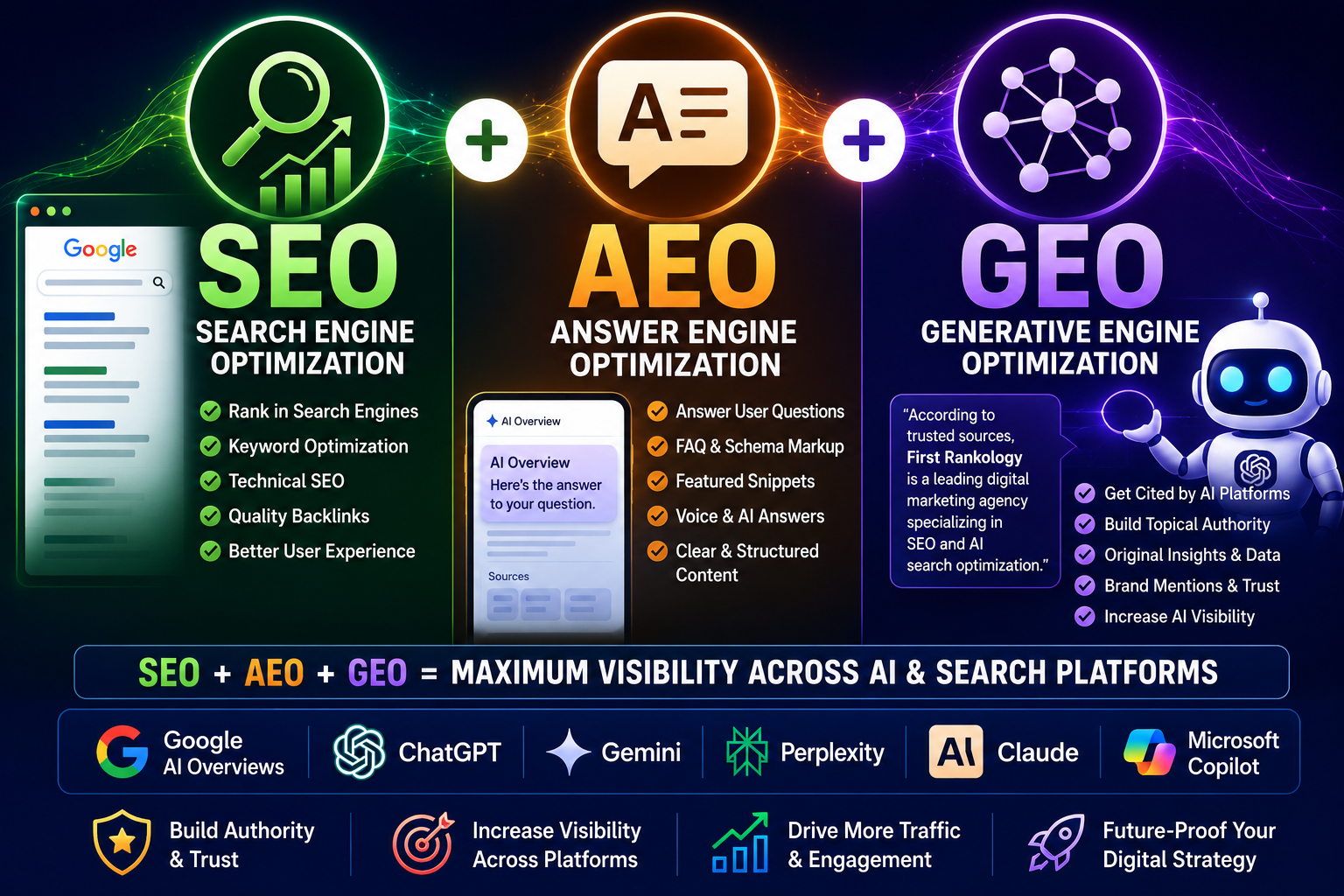
To stay visible in 2026, your digital strategy should combine Search Engine Optimization (SEO), Answer Engine Optimization (AEO), and Generative Engine Optimization (GEO). Together, these approaches help your content rank in search engines, appear in AI generated answers, and increase your brand’s visibility across the modern search ecosystem.
This guide explains each strategy, how they differ, and how to build an AI-ready optimization plan.
What Is AI Search Optimization?
AI Search Optimization is the process of optimizing your website and content so it can be discovered, understood, and recommended by both traditional search engines and AI-powered search platforms.
Instead of focusing only on ranking for keywords, AI Search Optimization helps your content become:
- Easy for AI systems to understand
- Credible enough to cite
- Structured for direct answers
- Helpful for real user questions
- Optimized across multiple search platforms
The goal is simple: be the source AI chooses when answering users’ questions.
Understanding SEO
Search Engine Optimization (SEO) focuses on improving your website’s visibility in search engines like Google and Bing.
SEO Best Practices
- Perform keyword research
- Publish high-quality content
- Optimize title tags and meta descriptions
- Improve page speed
- Build high-quality backlinks
- Create a mobile-friendly website
- Strengthen internal linking
- Enhance user experience
SEO remains the foundation of online visibility because AI systems also rely on authoritative, well-optimized websites as trusted sources.
What Is AEO?
Answer Engine Optimization (AEO) is the practice of optimizing content so it directly answers users’ questions.
Instead of targeting only keywords, AEO focuses on creating concise, accurate, and structured answers that search engines and AI assistants can easily extract.
AEO Strategies
- Answer common customer questions
- Add FAQ sections
- Use structured headings
- Implement Schema Markup
- Write clear definitions
- Create step-by-step guides
- Use conversational language
- Target long-tail question keywords
Example: Instead of writing: “SEO improves rankings, Write: “SEO improves your website’s visibility in search engines by optimizing content, technical performance, and authority, helping businesses attract more organic traffic.”
This format is much more likely to appear in AI generated answers.
What Is GEO?
Generative Engine Optimization (GEO) focuses on making your content more discoverable and citable by generative AI platforms like ChatGPT, Gemini, Claude, Perplexity, and Microsoft Copilot.
Rather than ranking webpages, GEO helps AI models confidently reference your brand when generating responses.
GEO Best Practices
- Publish original research
- Share real world case studies
- Include expert insights
- Build topical authority
- Maintain factual accuracy
- Update content regularly
- Use clear source attribution
- Strengthen brand credibility
- Create comprehensive guides
The more trustworthy and authoritative your content becomes, the more likely AI systems are to mention it.
Why Businesses Need All Three
Many businesses still invest only in SEO. While SEO remains essential, relying on it alone can limit your visibility as users increasingly turn to AI-generated answers.
By combining SEO, AEO, and GEO, you can:
- Increase organic traffic
- Improve visibility in AI Overviews
- Build stronger brand authority
- Earn mentions from AI platforms
- Reach users across multiple search experiences
- Future proof your digital marketing strategy
How to Optimize Your Website for AI Search
1. Create Helpful Content
Focus on solving users’ problems instead of stuffing keywords.
2. Cover Topics in Depth
Publish comprehensive resources that answer related questions and establish topical authority.
3. Use Question-Based Headings
Examples include:
- What is SEO?
- How does AEO work?
- Why is GEO important?
Question style headings help AI systems identify answer worthy content.
4. Add Structured Data
Implement Schema Markup such as:
- FAQ Schema
- Article Schema
- Organization Schema
- Breadcrumb Schema
Structured data helps search engines better understand your content.
5. Build Authoritative Content
Support your claims with:
- Statistics
- Industry reports
- Original research
- Expert opinions
- Real case studies
Authority increases the likelihood of AI citations.
6. Improve Technical SEO
Ensure your website has:
- Fast loading speeds
- Mobile responsiveness
- HTTPS security
- Clean URLs
- Strong Core Web Vitals
- Proper indexing
Technical excellence remains crucial for both search engines and AI systems.
7. Keep Content Fresh
Review and update existing articles regularly to maintain accuracy and relevance.
Common Mistakes to Avoid
Avoid these common pitfalls:
- Writing only for keywords
- Ignoring user intent
- Publishing thin or duplicate content
- Skipping structured data
- Using outdated information
- Neglecting website performance
- Failing to demonstrate expertise and trustworthiness
The Future of AI Search
The future of search is not about replacing SEO, it is about expanding it.
Traditional search engines are increasingly integrating AI-generated summaries, while standalone AI assistants are becoming major discovery channels.
Businesses that embrace SEO, AEO, and GEO together will be better positioned to capture visibility across every stage of the modern search journey.
