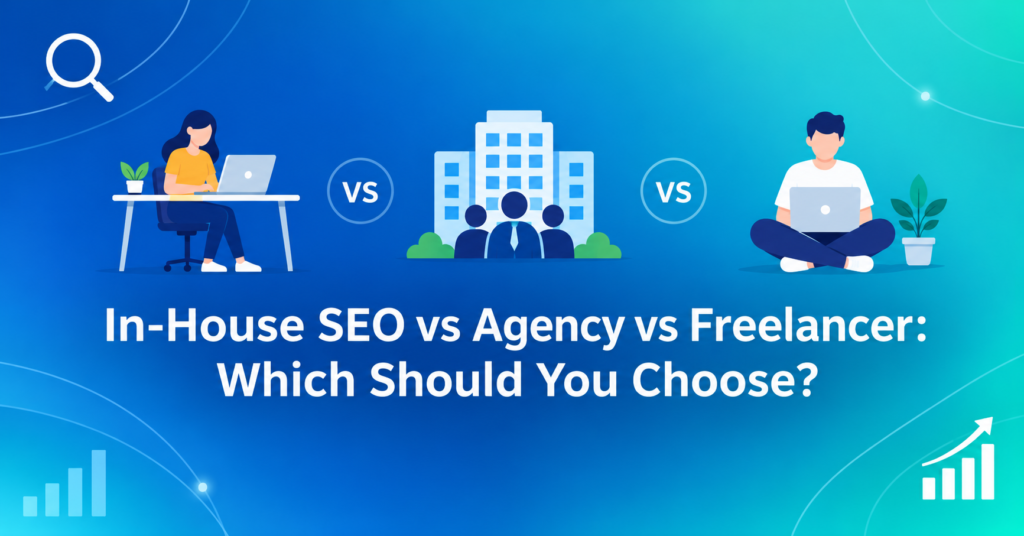
In-House SEO vs Agency vs Freelancer: Which Should You Choose?
In-House SEO vs Agency vs Freelancer: Which Should You Choose? Sooner or later, every business that wants to grow through search hits the same question: who should actually do the SEO? You can hire a full-time specialist, bring in a freelancer, or partner with a SEO agency. Each can work well, and each can fail badly when it is used in the wrong situation. This guide compares all three on cost, skills, speed, control and risk, so you can choose based on your business rather than on whoever pitched you last. Choose in-house if SEO is central to your business, you have a large website, and you can afford a team with a long-term budget. Choose a freelancer if you have a small site, a tight budget, and a clearly defined task, such as an audit or content optimization. Choose an agency if you need a full range of skills (technical, content, links, reporting) without building a team, and you want to scale up or down as needed. Choose a hybrid if you have an in-house marketer who needs specialist support. For many growing businesses, this is the sweet spot. Now let us look at each option in detail. Option 1: In-House SEO An in-house SEO is a full-time employee, or a small team, who works only on your website and your brand. Advantages Deep brand knowledge. They understand your products, customers, tone and internal processes better than any outsider. Full focus. Their time and attention go to one website, not a portfolio of clients. Faster internal coordination. They can work directly with developers, designers, sales and product teams. Long-term ownership. Knowledge stays inside the company. Disadvantages Higher fixed cost. Salary, benefits, tools, training and management time add up, and you pay whether or not there is enough work that month. Limited skill range. SEO covers technical work, content strategy, link building, analytics and more. One person rarely excels at all of them. Hiring risk. Good SEO talent is competitive to hire, and a single resignation can leave a gap of months. Narrow perspective. Someone who only sees one site may miss trends that agencies spot across many industries. Best for : Large ecommerce stores, publishers, SaaS companies, and enterprises where organic search is a primary revenue channel and there is enough ongoing work for a dedicated team. Option 2: Freelance SEO Specialist A freelancer is an independent consultant who works with you on a project or monthly basis. Advantages Lower cost. Freelancers have fewer overheads than agencies and often charge less. Flexibility. You can hire for a single audit, a content plan or a short project without a long contract. Direct communication. You work with the person doing the work, with no account managers in between. Specialist options. Some freelancers are very strong in one area, such as technical SEO or local SEO. Disadvantages Capacity limits. One person can only handle so much, and a growing campaign may outgrow them. Single point of failure. If they get sick, become busy or leave, your campaign stops. Uneven quality. The market has excellent freelancers and also many who oversell. Vetting takes effort. Narrow skillset. Few freelancers can deliver strong technical work, content, outreach and reporting all at once. Best for : Small businesses, startups with limited budgets, and companies that need a one-time audit, a strategy review or help with a specific task. Option 3: SEO Agency An agency gives you a team of specialists, typically strategists, technical SEOs, content writers, link builders and analysts, working under a defined process. Advantages Broad expertise. You get access to several skills for the price of one hire. Proven processes and tools. Established agencies already pay for premium tools and have workflows refined across many clients. Scalability. It is easier to expand or reduce the scope as your needs change. Continuity. If one team member leaves, the agency can replace them without stopping your campaign. Cross-industry insight. Agencies see what works across many websites and can spot changes in search earlier. Disadvantages Higher monthly cost than a freelancer. You pay for a team and its infrastructure. Less brand immersion. An agency will need time to learn your business, and may never know it as deeply as an employee. Quality varies widely. Some agencies overpromise, use generic playbooks or hand your account to junior staff. Dependence on communication. Results suffer if reporting is weak or your team is slow to approve changes. Best for : SMEs and mid-sized businesses that need a complete SEO program but are not ready to build an internal team, and companies expanding into new markets. What Does Each Option Cost? Exact costs depend on your country, industry and the experience level you need, so use these as relative guides rather than fixed prices. In-house: You are paying a salary plus benefits, software subscriptions (rank tracking, crawling, keyword research), and management time. A single mid-level hire can cost more per month than a typical agency retainer, and still lacks the writers, developers and link builders an agency provides. Freelancer: Usually the cheapest recurring option, with prices that vary greatly based on experience. Be cautious of rates that look too good to be true. Agency: Monthly retainers typically reflect a team’s time and tools. For a sense of local pricing, see our guides on SEO costs in Singapore and what to expect from SEO services in Singapore. When comparing, remember to count the hidden costs: recruitment, tools, training, management time and the cost of delays when one person cannot cover everything. Five Questions to Help You Decide How big is your website? A 10-page business site needs far less than a 10,000-product store. What is your budget, and is it ongoing? SEO needs steady investment for months. A one-off spend rarely moves the needle. Which skills do you lack? If you have a good writer but no technical expertise, you need a specialist partner rather than a replacement. How quickly do you need to start? Hiring takes weeks or months. Agencies