SEO

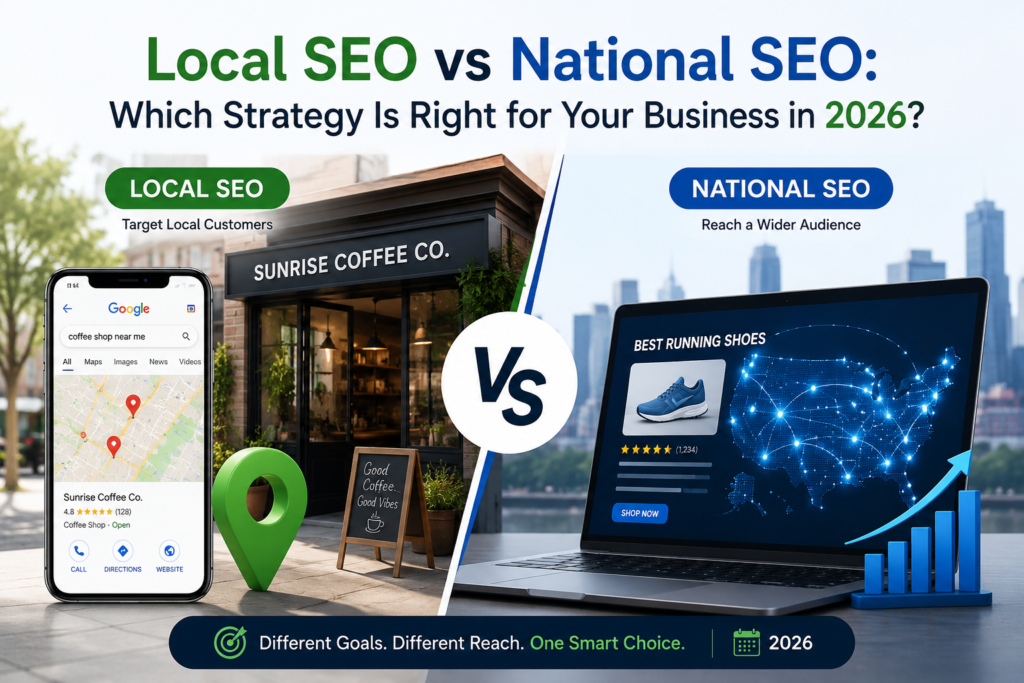
Local SEO vs National SEO comparison image showing a local storefront, Google Maps search, and nationwide SEO strategy on a laptop for businesses in 2026.
SEO

Local SEO vs National SEO: Which Strategy Is Right for Your Business in 2026?

Choosing the right SEO approach can improve your visibility, attract qualified leads, and maximize your marketing budget. In this guide, we’ll compare Local SEO and National SEO, explain their differences, and help you determine which strategy is the best fit for your business in 2026. Local SEO (Local Search Engine Optimization) focuses on improving your online visibility for location-based searches. Its goal is to help businesses appear in Google Search and Google Maps when people search for products or services in a specific area. Examples of Local Searches SEO agency near me Best dentist in Delhi Digital marketing company in Mumbai Coffee shop in Bangalore Local SEO is ideal for businesses that serve customers within a specific city or region. Key Components of Local SEO Google Business Profile optimization Local keyword targeting NAP (Name, Address, Phone Number) consistency Local citations and directories Customer reviews and ratings Location-specific landing pages Local backlinks National SEO (National Search Engine Optimization) targets customers across an entire country instead of a single location. Rather than optimizing for city-based keywords, businesses compete for broader, high-volume search terms. Examples of National Keywords Best SEO agency Digital marketing services Website development company Email marketing services National SEO is commonly used by businesses that operate nationwide or sell products and services online. Key Components of National SEO Comprehensive keyword research High-quality content marketing Technical SEO Strong backlink strategy Website authority building Optimized user experience Competitive industry analysis Who Should Choose Local SEO? Local SEO is the right strategy if your business depends on customers in a specific geographic area. Examples include: Restaurants Clinics Salons Gyms Real estate agencies Law firms Home service providers Local digital marketing agencies Benefits of Local SEO Higher visibility in local searches Increased phone calls and inquiries Better Google Maps rankings More website traffic from nearby customers Higher conversion rates due to local search intent Cost-effective marketing strategy Who Should Choose National SEO? National SEO works best for businesses that want to reach customers across multiple cities or the entire country. Examples include: eCommerce stores SaaS companies Online education platforms National service providers Technology companies Large brands Online marketplaces Benefits of National SEO Larger audience reach Higher brand authority Long-term organic traffic growth Increased nationwide visibility More opportunities for lead generation Can You Use Both Local and National SEO? Absolutely, Many businesses benefit from combining both strategies. For example, a digital marketing agency may optimize for: Local Keywords SEO agency in Delhi Digital marketing company in Noida While also targeting broader terms like: SEO services Content marketing agency Technical SEO services This hybrid strategy allows businesses to dominate local searches while expanding their national presence. Factors to Consider Before Choosing Your SEO Strategy Ask yourself the following questions: Where are my customers located? Do I have physical business locations? Do I provide services nationwide? What is my marketing budget? How competitive is my industry? What are my long-term business goals? Answering these questions will help you choose the SEO strategy that aligns with your growth plans. Local SEO vs National SEO: Which Delivers Better ROI? There isn’t a one-size-fits-all answer. Choose Local SEO if: You serve a specific city or region. You want faster results. Your budget is limited. Most customers are nearby. Choose National SEO if: You want to build a national brand. You sell products online. You serve clients across the country. You’re prepared for a long-term investment. The best ROI comes from matching your SEO strategy to your business model—not from choosing the most competitive option. SEO Trends for 2026 As search continues to evolve, both Local and National SEO strategies should include: AI-assisted content creation with human editing Answer-focused content for AI search experiences Strong E-E-A-T (Experience, Expertise, Authoritativeness, Trustworthiness) Mobile-first website optimization Core Web Vitals improvements Structured data (Schema Markup) Voice search optimization High-quality backlinks from relevant sources Businesses that adapt to these trends will be better positioned to maintain visibility in both traditional search and AI-powered search experiences.
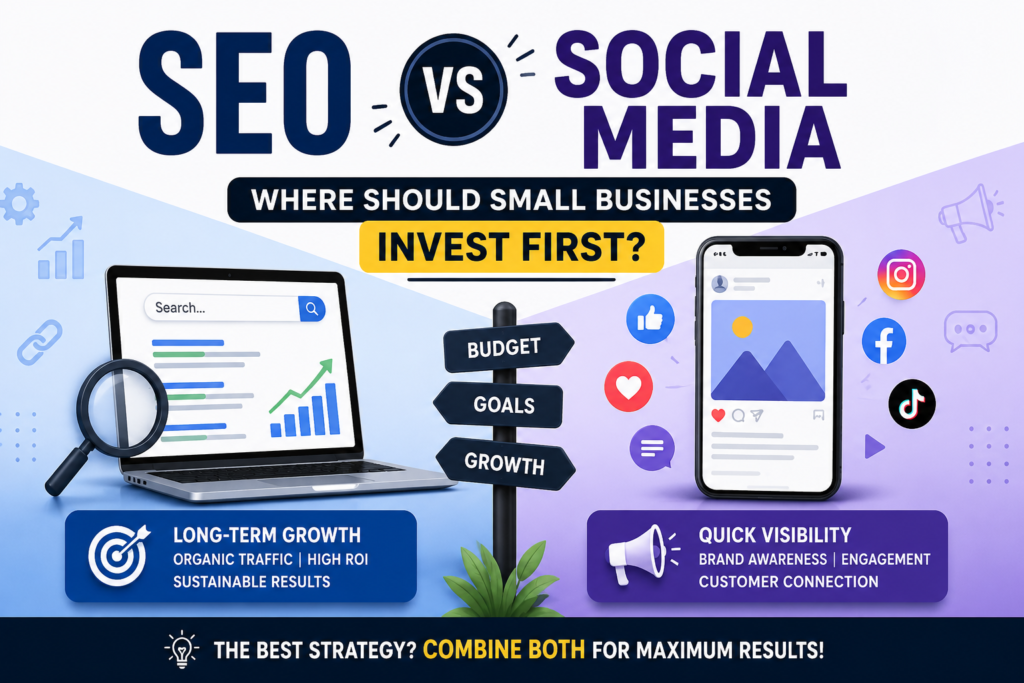
SEO vs Social Media comparison infographic for small businesses
SEO

SEO vs Social Media: Where Should Small Businesses Invest First?

Every small business wants one thing—more customers. But with limited marketing budgets, deciding where to invest can be challenging. Two of the most effective digital marketing channels are Search Engine Optimization (SEO) and Social Media Marketing (SMM). While both can help your business grow, they serve different purposes and deliver results in different ways. What Is SEO? Search Engine Optimization (SEO) is the process of improving your website so it ranks higher on search engines like Google and AI-powered search platforms. The goal is to attract users who are actively searching for products or services you offer. SEO includes: Keyword research On-page optimization Technical SEO Content marketing Link building Local SEO AI Search Optimization (GEO) Benefits of SEO Generates consistent organic traffic Builds trust and credibility Delivers long-term ROI Attracts high-intent customers Reduces dependence on paid advertising For example, if someone searches “best digital marketing company near me“, a well-optimized digital marketing company website has a strong chance of appearing in the search results. What Is Social Media Marketing? Social Media Marketing (SMM) involves promoting your business through platforms such as Instagram, Facebook, LinkedIn, TikTok, Pinterest, and X. Rather than waiting for customers to search, social media helps businesses reach people through engaging content, videos, stories, and paid campaigns. Common social media activities include: Short-form videos Product promotions Educational posts Customer engagement Brand storytelling Influencer collaborations Benefits of Social Media Marketing Builds brand awareness quickly Creates direct customer engagement Encourages sharing and referrals Supports community building Produces faster visibility for new businesses Which Delivers Better ROI? For most small businesses, SEO provides better long-term return on investment. A blog post or service page optimized for search can continue attracting visitors for years with minimal updates. In contrast, a social media post often receives the majority of its engagement within the first few days. SEO is like owning a valuable business asset that continues to generate traffic over time, while social media is more like renting attention—you need to keep creating content to maintain visibility. When Should Small Businesses Prioritize SEO? SEO should be your first investment if: You have a business website. Customers search online before making purchases. You offer local services. You want sustainable lead generation. Your budget is limited. You want long-term growth. Businesses that benefit greatly from SEO include: Local service providers Digital agencies Law firms Clinics Real estate companies Educational institutes E-commerce stores When Should You Invest in Social Media First? Social media may be the better starting point if you: Have just launched your business. Sell visually appealing products. Need quick brand awareness. Depend on influencer marketing. Want to build an online community. Frequently launch offers or promotions. Industries that perform exceptionally well on social media include: Fashion Beauty Food Fitness Travel Lifestyle brands Why Combining SEO and Social Media Works Best The strongest digital marketing strategy doesn’t choose one over the other—it combines both. SEO helps people discover your business through search engines, while social media strengthens your brand and keeps your audience engaged. For example: Publish an SEO-optimized blog on your website. Share it through Instagram and LinkedIn. Create a short video summarizing the article. Drive traffic back to your website. Convert visitors into leads through optimized landing pages. This integrated approach creates a continuous flow of traffic, engagement, and conversions. Common Mistakes Small Businesses Make Avoid these common pitfalls: Posting on social media without a website Ignoring Google Business Profile optimization Publishing content without keyword research Focusing only on followers instead of conversions Neglecting technical SEO Inconsistent posting schedules Not tracking performance using analytics SEO and Social Media Are Stronger Together Think of SEO as the engine that continuously drives qualified visitors to your website, while social media acts as the amplifier that expands your reach and builds relationships. Businesses that integrate both channels generally enjoy: Increased brand visibility Better search rankings Higher website traffic More qualified leads Improved customer trust Stronger long-term business growth If you’re a small business with a limited marketing budget, SEO should generally be your first investment. It builds a strong digital foundation, attracts customers with high purchase intent, and continues delivering value over time.  

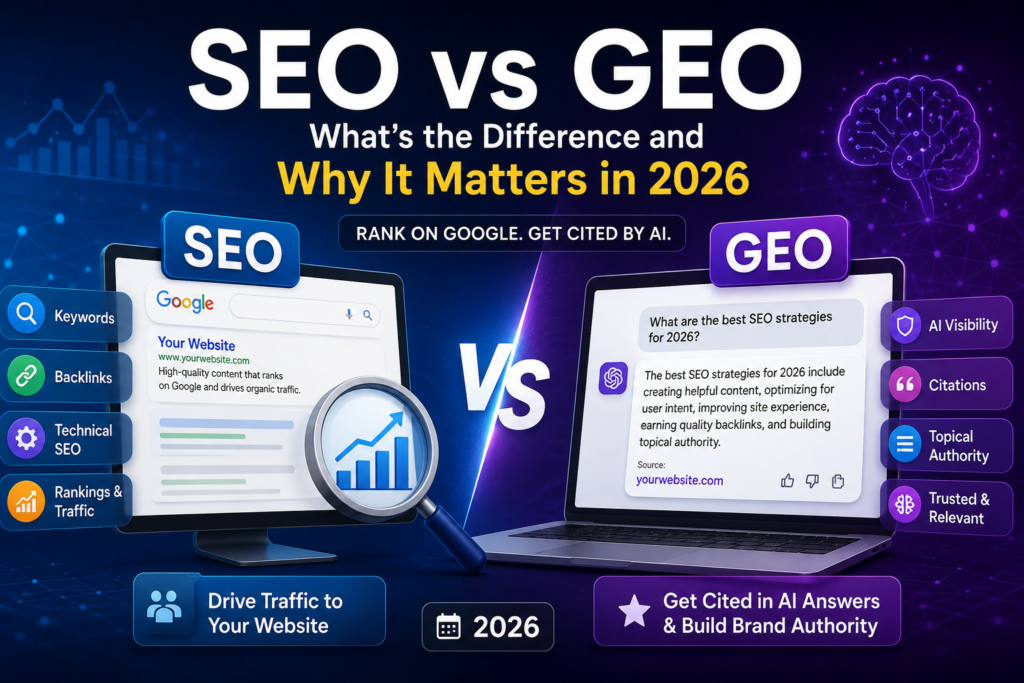
SEO vs GEO comparison infographic showing traditional Search Engine Optimization alongside Generative Engine Optimization, highlighting Google rankings, AI search visibility, citations, topical authority, and key differences for digital marketing in 2026.
SEO

SEO vs GEO: What’s the Difference and Why It Matters in 2026

Search marketing is undergoing its biggest transformation since Google’s early days. While Search Engine Optimization (SEO) remains essential for improving rankings on traditional search engines, the rapid adoption of AI-powered search platforms like ChatGPT, Google AI Overviews, Perplexity AI, and Gemini has introduced a new optimization strategy known as Generative Engine Optimization (GEO). What Is SEO? Search Engine Optimization (SEO) is the process of improving a website’s visibility on search engines like Google and Bing. The goal is to rank higher for relevant keywords so users can discover your website through organic search results. SEO focuses on helping search engines understand your content while providing users with valuable information. What Is GEO? Generative Engine Optimization (GEO) is the practice of optimizing content so AI-powered search engines and large language models can understand, trust, and reference your information when generating answers. Instead of simply ranking webpages, GEO helps your content become part of AI-generated responses. Popular AI search platforms include: ChatGPT Search Google AI Overviews Google Gemini Perplexity AI Microsoft Copilot When someone asks: “What’s the best SEO strategy for small businesses?” An AI engine may summarize information from multiple trusted websites instead of showing only traditional search results. GEO increases the likelihood that your content is selected as one of those trusted sources.   Why GEO Matters in 2026 AI-powered search is changing how people discover information. Instead of browsing multiple websites, users increasingly rely on AI assistants to provide complete answers in seconds. This shift means businesses need to optimize not only for search engines but also for AI models that summarize and recommend content. Some major trends driving GEO include: Growing adoption of AI-powered search Increased use of conversational queries More zero-click searches Greater emphasis on trusted sources AI-generated summaries appearing above traditional search results Businesses that adapt early can gain a significant competitive advantage. SEO Is Not Dead—It’s Evolving Many marketers ask: “Is SEO dead?” and, The answer is no. SEO remains the foundation of online visibility. In fact, strong SEO often supports better GEO performance because AI systems tend to rely on authoritative, well-structured, and trustworthy content. Think of SEO as building a strong library, while GEO helps AI librarians find and recommend the best books. The future isn’t SEO or GEO. It’s SEO + GEO together. Common Mistakes to Avoid Publishing AI-generated content without human review Focusing only on keywords Ignoring search intent Creating thin or duplicate content Neglecting technical SEO Forgetting structured data Not updating outdated articles Writing for algorithms instead of users The Future of Search Marketing Search is becoming increasingly conversational, personalized, and AI-driven. Businesses that rely solely on traditional SEO risk losing visibility as AI-generated answers become more common. Forward-thinking brands are already investing in: AI-ready content Semantic optimization Entity-based SEO Topical authority GEO strategies Voice search optimization Answer-focused content The companies that embrace both SEO and GEO today will be better positioned to earn visibility across traditional search engines and AI-powered search experiences.    
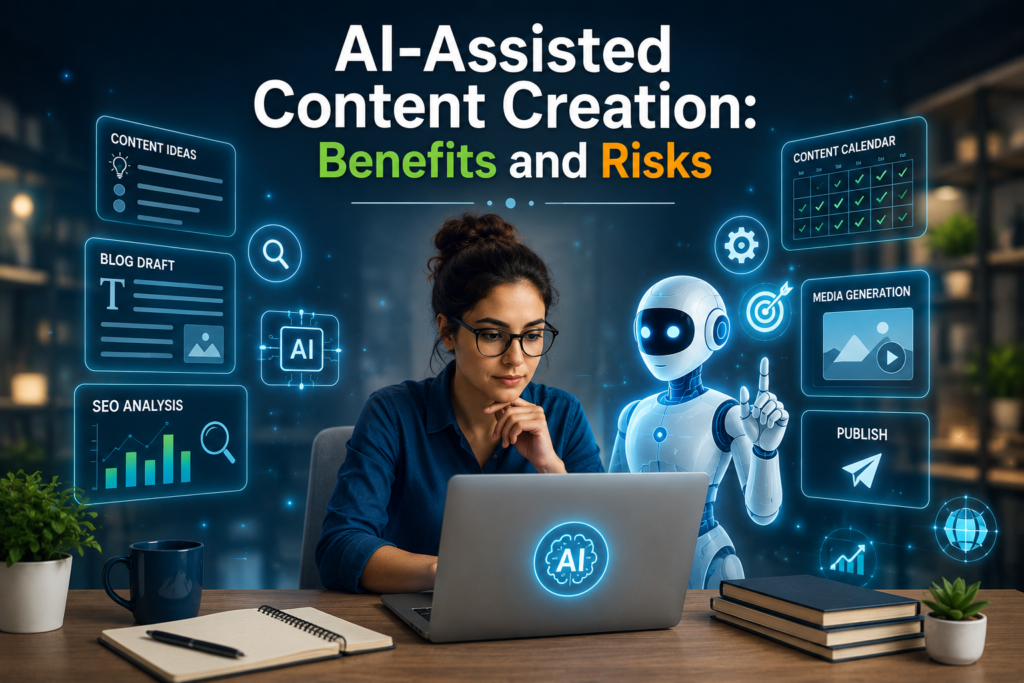
AI-powered content creation dashboard with digital marketing analytics, content workflow automation, and human collaboration
SEO

AI-Assisted Content Creation: Benefits and Risks

Artificial Intelligence (AI) has transformed the way businesses create and distribute content. From generating blog posts and social media captions to creating product descriptions and email campaigns, AI powered tools are helping marketers and content creators work faster and more efficiently than ever before. While AI assisted Content Writing offers numerous advantages, it also comes with potential risks that businesses must understand and manage effectively. What Is AI-Assisted Content Creation? AI assisted content creation refers to the use of artificial intelligence tools to support the content development process. These tools can generate ideas, write drafts, optimize content for search engines, create images, and even personalize messaging for different audiences. Popular AI platforms such as ChatGPT, Gemini, and Claude have made content creation more accessible and scalable for businesses of all sizes. Rather than replacing human writers, AI works best as a collaborative tool that enhances productivity and creativity. Benefits of AI-Assisted Content Creation 1. Increased Productivity One of the biggest advantages of AI is its ability to speed up content production. Tasks that once took hours, such as researching topics, creating outlines, or drafting articles, can now be completed in minutes. This allows content teams to focus on strategy, creativity, and audience engagement. 2. Cost Efficiency Hiring writers, designers, and editors for every content project can be expensive. AI tools help reduce costs by automating repetitive tasks and enabling smaller teams to produce more content without significantly increasing budgets. 3. Content Scalability Businesses often need large volumes of content for blogs, social media, email marketing, and SEO campaigns. AI enables organizations to scale their content production efforts while maintaining a consistent publishing schedule. 4. Improved SEO Optimization Modern AI tools can analyze keywords, suggest content structures, generate meta descriptions, and identify optimization opportunities. This helps businesses create search-friendly content that has a better chance of ranking in search engines. 5. Idea Generation and Creativity Support Content creators sometimes struggle with writer’s block or finding fresh topics. AI can generate content ideas, headlines, and outlines that inspire new directions and improve content planning. Risks of AI-Assisted Content Creation 1. Accuracy and Misinformation AI generated content is not always accurate. Since AI models rely on existing data and patterns, they may produce outdated, misleading, or incorrect information. Publishing unverified content can damage a brand’s credibility and trustworthiness. 2. Lack of Originality AI often generates content based on patterns learned from existing sources. As a result, some outputs may sound generic or similar to content already available online. Businesses that rely solely on AI risk creating content that lacks a unique brand voice and perspective. 3. Quality Concerns While AI can produce content quickly, speed does not always equal quality. AI generated articles may miss important context, emotional depth, storytelling elements, or industry specific insights that human writers naturally provide. 4. Ethical and Copyright Issues Questions surrounding content ownership and copyright continue to evolve as AI technology advances. Businesses should be cautious when using AI generated text, images, or designs and ensure compliance with legal and ethical standards. 5. Overdependence on Automation Excessive reliance on AI can reduce critical thinking and creativity within content teams. Human expertise remains essential for developing brand messaging, understanding audience needs, and making strategic decisions. Best Practices for Using AI in Content Creation To maximize the benefits while minimizing the risks, businesses should adopt a balanced approach: Use AI as a content assistant, not a complete replacement for human creators. Fact check all AI generated information before publishing. Edit and personalize content to match your brand voice. Combine AI efficiency with human creativity and expertise. Follow ethical guidelines and copyright best practices. Continuously monitor content performance and quality. As AI technology continues to evolve, organizations that use it responsibly will gain a competitive advantage while maintaining strong connections with their audiences.

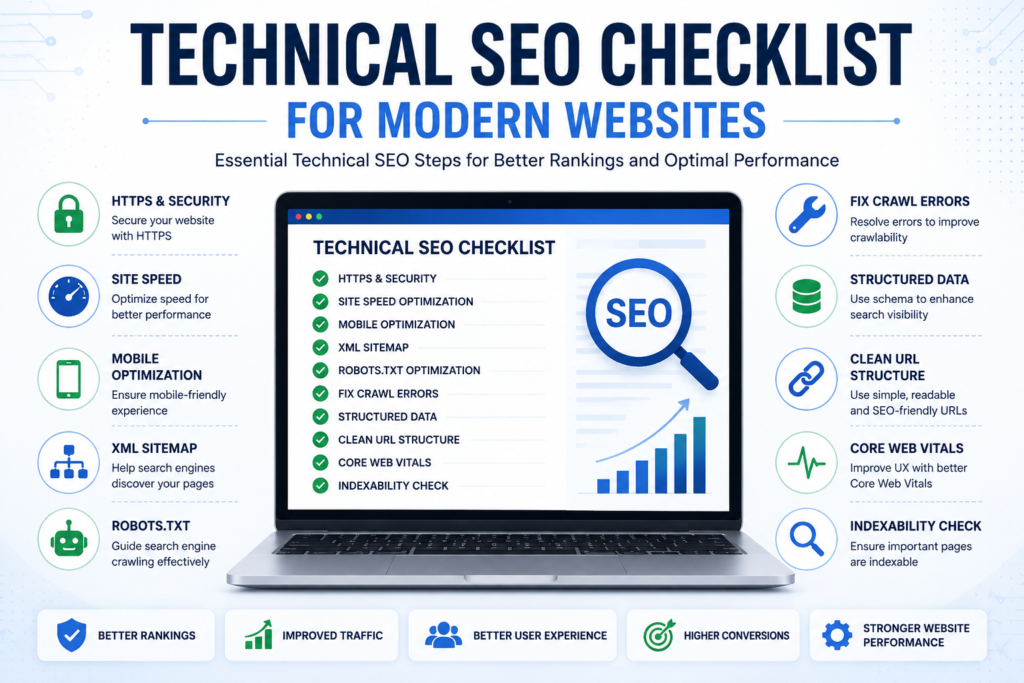
Technical SEO Checklist for Modern Websites infographic featuring a laptop with SEO audit elements, HTTPS security, site speed optimization, mobile SEO, XML sitemap, structured data, Core Web Vitals, and indexing best practices.
SEO

Technical SEO Checklist: Essential Website Optimization Strategies for 2026

Technical SEO is essential for ensuring search engines can efficiently crawl, index, and rank your website. From site speed and mobile optimization to structured data and Core Web Vitals, a strong technical foundation helps improve search visibility and user experience. This checklist covers the key technical SEO elements every modern website should optimize in 2026. 1. Ensure Your Website Uses HTTPS Security is a ranking factor for Google. Websites using HTTPS provide encrypted communication between users and the server, protecting sensitive information and building trust. Checklist: Install an SSL certificate. Redirect all HTTP URLs to HTTPS. Check for mixed-content issues. 2. Improve Website Speed Page speed directly impacts user experience and search rankings. Slow-loading websites often experience higher bounce rates and lower conversions. Checklist: Compress images using modern formats like WebP. Enable browser caching. Minify CSS, JavaScript, and HTML files. Use a Content Delivery Network (CDN). Reduce server response times. Recommended Tool: Google PageSpeed Insights 3. Optimize for Mobile Devices With Google’s mobile-first indexing, your mobile website version is now the primary version used for ranking and indexing. Checklist: Use responsive web design. Ensure text is readable without zooming. Make buttons and navigation mobile-friendly. Test mobile usability regularly. 4. Create and Submit an XML Sitemap An XML sitemap helps search engines discover and index your website pages more efficiently. Checklist: Generate an updated XML sitemap. Include important pages only. Submit the sitemap through Google Search Console. Remove broken or redirected URLs. 5. Optimize Robots.txt File The robots.txt file tells search engines which pages they can or cannot crawl. Checklist: Allow search engines to access important content. Block unnecessary admin or duplicate pages. Add your sitemap URL. Regularly review crawl directives. 6. Fix Crawl Errors Crawl errors prevent search engines from properly accessing your content. Checklist: Monitor Google Search Console for crawl issues. Fix 404 errors. Resolve redirect loops. Repair broken internal links. Regular monitoring helps maintain a healthy website structure. 7. Improve URL Structure Clean URLs are easier for users and search engines to understand. Best Practices: Keep URLs short and descriptive. Include relevant keywords. Use hyphens instead of underscores. Avoid unnecessary parameters whenever possible. Example: Good: example.com/technical-seo-checklist Bad: example.com/page?id=12345 8. Implement Structured Data Structured data helps search engines understand your content and can improve visibility through rich results. Common Schema Types: Article Schema FAQ Schema Local Business Schema Product Schema Review Schema Proper schema implementation can increase click-through rates and enhance search appearance. 9. Eliminate Duplicate Content Duplicate content can confuse search engines and dilute ranking signals. Checklist: Use canonical tags. Consolidate similar pages. Avoid publishing identical content across multiple URLs. Manage URL parameters correctly. 10. Strengthen Internal Linking Internal links help search engines discover pages and distribute authority across your website. Checklist: Link related content naturally. Use descriptive anchor text. Avoid orphan pages. Create topic clusters around core subjects. A strong internal linking structure improves both SEO and user navigation. 11. Monitor Indexability Not every page should be indexed, but important pages must be accessible to search engines. Checklist: Review “noindex” tags. Check canonical implementations. Verify indexed pages in Google Search Console. Ensure critical pages are crawlable. 12. Optimize Core Web Vitals Core Web Vitals measure real-world user experience and remain important ranking signals. Focus on: Largest Contentful Paint (LCP) Interaction to Next Paint (INP) Cumulative Layout Shift (CLS) Improving these metrics leads to better user satisfaction and search performance.  

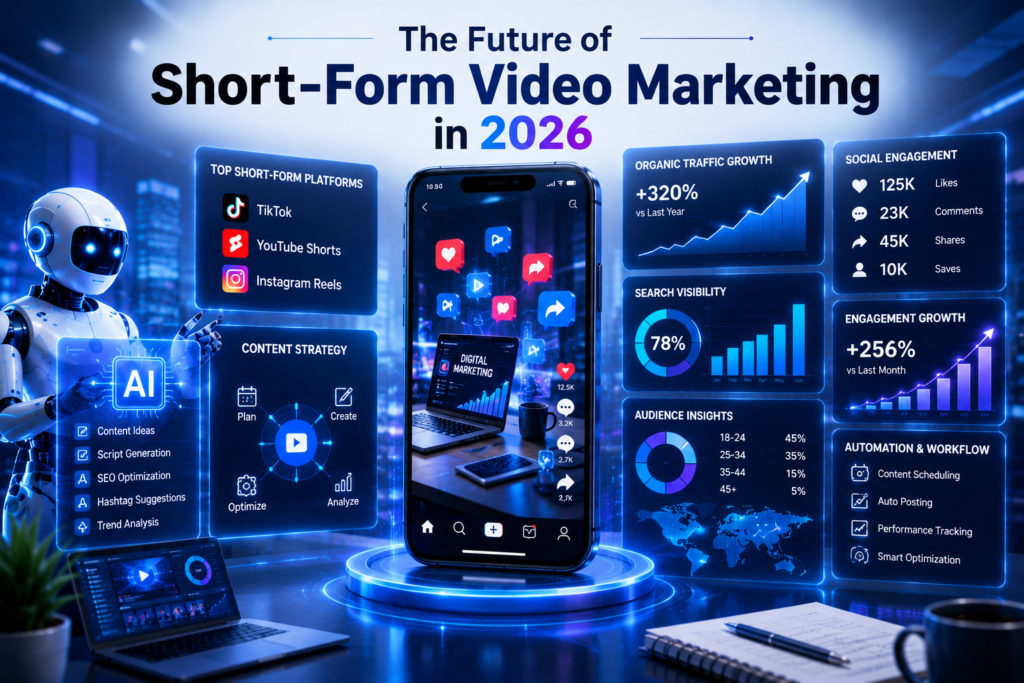
Futuristic short-form video marketing concept featuring AI-powered content creation tools, social media analytics dashboards, SEO growth metrics, and a smartphone displaying digital marketing content in a modern blue-themed workspace.
SEO

Short-Form Video Trends Dominating 2026

In 2026, short-form video continues to dominate the digital landscape. From TikTok and Instagram Reels to YouTube Shorts and Facebook Reels, vertical video content has become the preferred way people consume information, discover brands, and engage with creators. What started as a trend has now become the foundation of modern content marketing. With billions of daily video views across social platforms, businesses and creators must adapt to evolving audience preferences and platform algorithms to stay competitive. Here are the biggest short-form video trends dominating 2026 and how marketers can leverage them for growth. 1. AI-Powered Content Creation Is Going Mainstream Artificial intelligence is transforming how videos are created. AI tools can now generate captions, edit clips, suggest hooks, optimize posting times, and even create video drafts from text prompts. Rather than replacing creators, AI is helping them produce content faster and more consistently. As a result, brands can publish more frequently without sacrificing quality. However, audiences still value authenticity. The most successful creators use AI to streamline production while maintaining a human voice and genuine storytelling. 2. Authentic Content Outperforms Polished Production One of the biggest shifts in 2026 is the preference for authentic, relatable content over highly produced advertisements. Users are increasingly drawn to behind-the-scenes footage, day-in-the-life videos, quick tips, and real customer experiences. Consumers are becoming more skeptical of overly scripted marketing messages. Instead, they engage with content that feels natural and trustworthy. Brands that showcase real people, honest experiences, and practical insights often see higher engagement rates than those relying solely on polished promotional videos. 3. Multi-Platform Video Distribution Is Essential Posting on a single platform is no longer enough. Successful creators and businesses are distributing the same content across TikTok, Instagram Reels, YouTube Shorts, Facebook Reels, and even LinkedIn video. This strategy maximizes reach while reducing content creation costs. A single well-performing video can generate engagement across multiple platforms, helping brands reach diverse audiences and reduce dependence on one algorithm. Industry observations show that creators publishing on multiple platforms often achieve significantly higher overall reach. 4. Educational Micro-Content Is Exploding People increasingly use social media platforms as search engines. Instead of searching Google, many users turn to TikTok, Instagram, or YouTube for tutorials, product reviews, and quick answers. This behavior has fueled the rise of educational micro-content. Short videos that explain a concept, solve a problem, or teach a skill in under 60 seconds are generating impressive engagement. Whether you’re a digital marketer, fitness coach, consultant, or business owner, creating value-driven educational content can position you as an authority in your niche. 5. Content Repurposing Is Becoming a Core Strategy Brands are no longer creating separate videos for every platform. Instead, they are repurposing long-form content such as webinars, podcasts, interviews, and live streams into dozens of short clips. This “content clipping” strategy allows marketers to maximize the value of every piece of content they create. Major brands and creators are increasingly investing in systems that transform a single long-form video into multiple short-form assets for social media distribution. For businesses with limited resources, content repurposing offers one of the highest returns on investment in digital marketing. 6. Social Commerce Through Video Is Growing Rapidly Short-form videos are no longer just for entertainment. They are becoming powerful sales tools. Platforms are integrating shopping features directly into video experiences, allowing users to discover, evaluate, and purchase products without leaving the app. Product demonstrations, customer testimonials, and creator reviews are driving purchasing decisions more effectively than traditional advertisements. Businesses that combine engaging storytelling with clear product value are seeing stronger conversion rates from short-form content. 7. Strong Hooks Matter More Than Ever Attention spans remain short, making the first few seconds of a video critical. The most successful creators focus heavily on creating compelling hooks that stop users from scrolling. Questions, surprising facts, bold statements, and curiosity-driven openings are all effective ways to capture attention quickly. In 2026, content quality alone isn’t enough—the ability to grab attention instantly often determines whether a video succeeds or disappears in the feed. 8. Short-Form and Long-Form Content Are Working Together While short-form video dominates discovery, long-form content is making a comeback for deeper engagement. Many creators use short videos as entry points that lead audiences to podcasts, webinars, YouTube channels, and longer educational content. This content ecosystem helps businesses attract attention with short videos and build trust through long-form experiences. Rather than competing, short-form and long-form content now complement each other as part of a complete content strategy. Short-form video is no longer an optional marketing tactic—it is the primary way people consume content online. In 2026, success depends on authenticity, educational value, AI-assisted workflows, multi-platform distribution, and strategic content repurposing.  

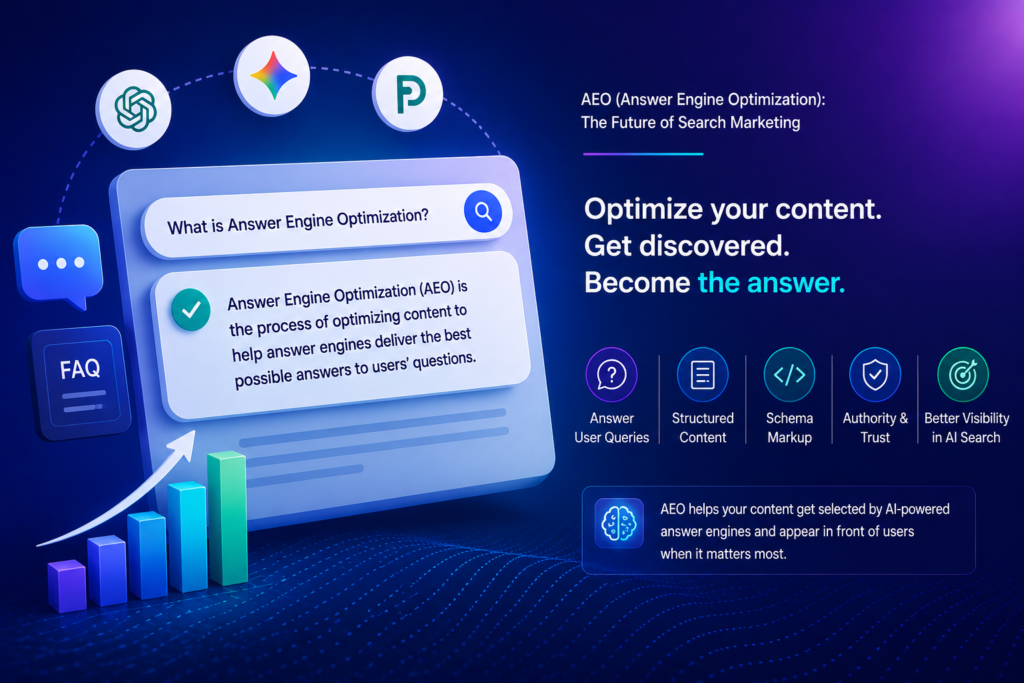
AEO (Answer Engine Optimization) concept showing AI-powered search, structured content, and digital marketing analytics for improved search visibility.
SEO

AEO (Answer Engine Optimization): The Future of Search Marketing

What Is Answer Engine Optimization (AEO)? Answer Engine Optimization (AEO) is the process of optimizing your content so that AI-powered search engines and answer platforms can easily understand, extract, and present your information as direct answers to users’ questions. Unlike traditional SEO, which focuses on improving rankings and driving clicks, AEO focuses on becoming the trusted source that AI systems cite when generating answers. The goal is simple: make your content the answer that search engines and AI assistants choose to display. Why AEO Matters in 2026 The way people search online is changing dramatically. Instead of typing short keywords, users now ask complete questions such as: What is the best SEO strategy for small businesses? How can I improve my website’s AI search visibility? What is the difference between SEO and AEO? AI-powered platforms analyze multiple sources and generate concise responses instantly. If your content is optimized for these answer engines, your brand can gain visibility even when users never click through to your website. This shift makes AEO one of the most important digital marketing strategies for businesses looking to stay competitive.   AEO vs Traditional SEO While SEO and AEO work together, they have different objectives. Traditional SEO Focuses On: Keyword rankings Organic traffic Backlinks Search engine result pages Click-through rates AEO Focuses On: Direct answers AI citations Structured content Question-based optimization Authority and trust signals Think of AEO as the next evolution of SEO rather than a replacement. Key Elements of Successful AEO 1. Create Question-Based Content Most AI searches begin with a question. Structure your content around common user queries and provide clear, concise answers. Examples: What is Answer Engine Optimization? How does AEO improve online visibility? Why is AEO important for businesses? 2. Use Clear Headings and Structure AI systems prefer well-organized content. Use logical heading structures (H1, H2, H3) and break information into easy-to-understand sections. This helps answer engines quickly identify relevant information. 3. Optimize for Featured Snippets Featured snippets often serve as training signals for answer engines. Create short, direct answers near the beginning of each section. Aim to answer important questions within 40–60 words before expanding on the topic. 4. Implement Structured Data Schema markup helps search engines understand your content more effectively. Useful schema types include: FAQ Schema Article Schema How-To Schema Organization Schema Structured data increases the likelihood of your content being selected for AI-generated answers. 5. Build Topical Authority AI platforms prioritize trustworthy and authoritative sources. Create comprehensive content clusters around your niche, regularly update information, and demonstrate expertise through high-quality content. The more authority your website builds, the more likely answer engines are to reference your content. Best Practices for AEO Success To improve your answer engine visibility: Write content in a conversational tone. Focus on user intent rather than keywords alone. Include FAQ sections. Use simple and direct language. Support claims with credible sources. Optimize for mobile and page speed. Keep content accurate and regularly updated. These practices help both traditional search engines and AI-powered answer platforms understand and trust your content. The Future of Search Marketing The future of search is becoming increasingly answer-focused. AI assistants are changing how people discover information, products, and services online. Businesses that adapt early to Answer Engine Optimization will gain a significant advantage by increasing visibility across AI-powered platforms. Rather than competing solely for rankings, brands can position themselves as trusted sources that answer engines rely on. As AI search continues to grow, combining SEO, AEO, and Generative Engine Optimization (GEO) will be essential for long-term digital success.  

SEO

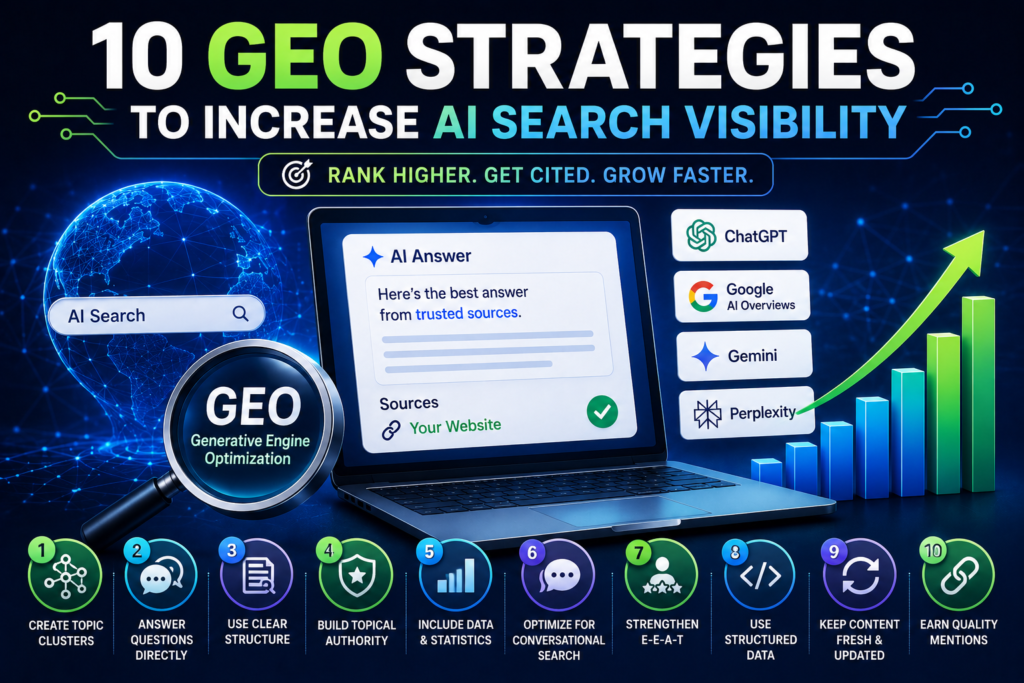
10 GEO Strategies to Increase AI Search Visibility in 2026

This shift has introduced a new concept called Generative Engine Optimization (GEO)—the process of optimizing your content so AI systems can discover, understand, and reference it in their responses. What Is GEO? Generative Engine Optimization (GEO) focuses on making content easily accessible and understandable for AI-powered search engines and large language models. Unlike traditional SEO, which aims to rank web pages on search result pages, GEO aims to make your content the source AI systems use when generating answers. 1. Create Topic-Focused Content Clusters AI models prefer content that demonstrates expertise and covers a topic comprehensively. Instead of publishing random articles, build content clusters around a central topic. Example: If you offer SEO services, create related articles such as: What Is SEO? Local SEO Guide E-commerce SEO Strategies Technical SEO Checklist SEO vs GEO Comparison This helps AI understand your authority within a specific subject area. 2. Answer Questions Directly AI platforms are designed to answer user questions quickly. Structure your content around real user queries and provide clear answers within the first few paragraphs. Example: Question: What is GEO? Answer: GEO (Generative Engine Optimization) is the practice of optimizing content for AI-powered search engines so that it can be cited and referenced in AI-generated responses. Direct answers increase the chances of AI systems using your content. 3. Use Clear Heading Structures Well-structured content helps AI models identify important information and extract answers accurately. Avoid large blocks of text without headings. Organize content using: H1 for the main title H2 for major sections H3 for supporting information 4. Build Topical Authority AI systems tend to trust websites that consistently publish high-quality content within a specific niche. Focus on becoming an authority in one area before expanding. For example: SEO Agency : SEO, GEO, Digital Marketing Social Media Agency : Instagram, LinkedIn, Content Marketing Consistency improves your chances of being cited by AI platforms. 5. Include Statistics and Original Data AI-generated responses often prioritize factual and data-backed information. Unique insights make your content more valuable and citation-worthy. Whenever possible: Add industry statistics Conduct surveys Share case studies Publish original research 6. Optimize for Conversational Search Users now search using natural language. Instead of targeting only keywords like: “SEO agency Singapore”. Optimize for conversational queries such as: Which SEO agency is best for small businesses in Singapore? How much does SEO cost in Singapore? Is SEO worth it in 2026? This aligns with how people interact with AI assistants. 7. Strengthen Your E-E-A-T Signals Google and AI systems increasingly evaluate: Experience Expertise Authoritativeness Trustworthiness Ways to improve E-E-A-T: Add author bios Showcase certifications Publish client case studies Include company information Display customer testimonials Trust signals increase the likelihood of AI platforms referencing your content. 8. Use Structured Data Markup Schema markup helps search engines and AI systems understand your content better. Important schema types include: Article Schema FAQ Schema Organization Schema Local Business Schema Review Schema Structured data provides context that improves content discoverability. 9. Keep Content Fresh and Updated AI-powered search favors current and accurate information. Update articles regularly by: Refreshing statistics Adding new examples Revising outdated recommendations Including recent trends A yearly content update strategy can significantly improve visibility. 10. Earn High-Quality Brand Mentions AI systems often evaluate information across multiple sources. The more your brand is mentioned on trusted websites, the stronger your authority becomes. Focus on: Guest posting Digital PR Industry publications Business directories Expert interviews Brand mentions increase credibility and improve your chances of appearing in AI-generated responses. By implementing these 10 GEO strategies, you can position your brand as a trusted source, increase visibility in AI-generated answers, and stay ahead of competitors in 2026 and beyond. Don’t replace SEO with GEO—combine them. Traditional search and AI search are now working together, and successful brands will optimize for both.  

Futuristic AI brain made of glowing neural networks analyzing search data, surrounded by SEO analytics dashboards, search interface, traffic growth charts, and AI chip technology in a modern digital environment.
SEO

How AI Search Is Changing SEO Strategies in 2026

Artificial Intelligence (AI) is transforming the way people search for information online. Traditional search engines are no longer the only source users rely on. Today, platforms like ChatGPT, Google AI Overviews, Gemini, and Perplexity are providing direct answers to user queries, changing how people discover content and interact with websites. What Is AI Search? AI search uses artificial intelligence to understand user queries and provide direct, conversational answers. Instead of showing a list of web pages, AI search tools summarize information from multiple sources and present it in an easy-to-understand format. For example, if a user asks, “How can I improve my website’s SEO?” An AI search platform may provide a detailed answer immediately rather than requiring the user to visit several websites. This shift is changing the way users interact with search engines and the way businesses approach SEO. Why AI Search Matters for SEO The rise of AI search is influencing how content is discovered online. Users are increasingly looking for quick and accurate answers instead of browsing through multiple search results. As a result, search engines are prioritizing content that is: Helpful and informative Well-structured Easy to understand Relevant to user intent Trustworthy and authoritative Websites that create valuable content and answer user questions clearly are more likely to gain visibility in both traditional search results and AI-generated responses. How AI Search Is Changing SEO Strategies 1. User Intent Is More Important Than Keywords For years, SEO focused heavily on keyword optimization. While keywords still matter, AI search engines are much better at understanding the meaning behind a search query. Instead of targeting a single keyword repeatedly, businesses should focus on understanding what users actually want to know. Content should answer questions, solve problems, and provide useful information. For example, rather than creating content solely around the keyword “SEO services,” businesses should address related questions such as: What are SEO services? How do SEO services help businesses grow? Are SEO services worth the investment? This approach helps content align with user intent and improves its chances of being featured in AI-generated answers. 2. Content Quality Is Becoming a Major Ranking Factor AI search platforms prioritize content that demonstrates expertise and provides genuine value. Thin content written only to rank for keywords is becoming less effective. Instead, businesses should focus on creating detailed, accurate, and well-researched articles that address user needs. High-quality content should: Include practical insights Answer common questions Be easy to read Provide up-to-date information Demonstrate industry expertise The more useful your content is, the more likely it is to be referenced by AI search systems. 3. Structured Content Improves Visibility AI tools prefer content that is organized and easy to understand. To improve visibility, businesses should structure content using: Clear headings and subheadings Bullet points Numbered lists FAQ sections Short paragraphs Well-structured content helps AI systems quickly identify key information and increases the likelihood of appearing in featured snippets and AI summaries. 4. Answer Engine Optimization (AEO) Is Gaining Importance One of the biggest changes in SEO is the rise of Answer Engine Optimization (AEO). AEO focuses on optimizing content so AI-powered search engines can easily extract and present it as a direct answer to user questions. Businesses can improve AEO by: Using question-based headings Adding FAQ sections Providing concise answers Implementing schema markup Writing in a conversational tone As AI search becomes more popular, AEO will become an essential part of every SEO strategy. 5. Building Topical Authority Matters More Than Ever Search engines and AI platforms want to recommend content from trusted sources. Instead of publishing random articles, businesses should focus on creating content clusters around specific topics. For example, a digital marketing agency could publish articles on: Technical SEO Local SEO SEO audits Link building AI search optimization Creating multiple pieces of related content helps establish expertise and increases trust with both search engines and AI systems. How Businesses Can Prepare for AI Search To stay competitive in 2026, businesses should focus on creating content that serves both users and AI platforms. Some best practices include: Prioritizing user intent over keyword stuffing Publishing high-quality, original content Optimizing for FAQs and conversational searches Using schema markup to improve content understanding Strengthening internal linking strategies Updating older content regularly These strategies can help improve visibility across traditional search results and AI-powered search experiences. The future of SEO is not about choosing between traditional search and AI search. It is about combining both approaches to create content that is helpful, trustworthy, and easy to understand.  
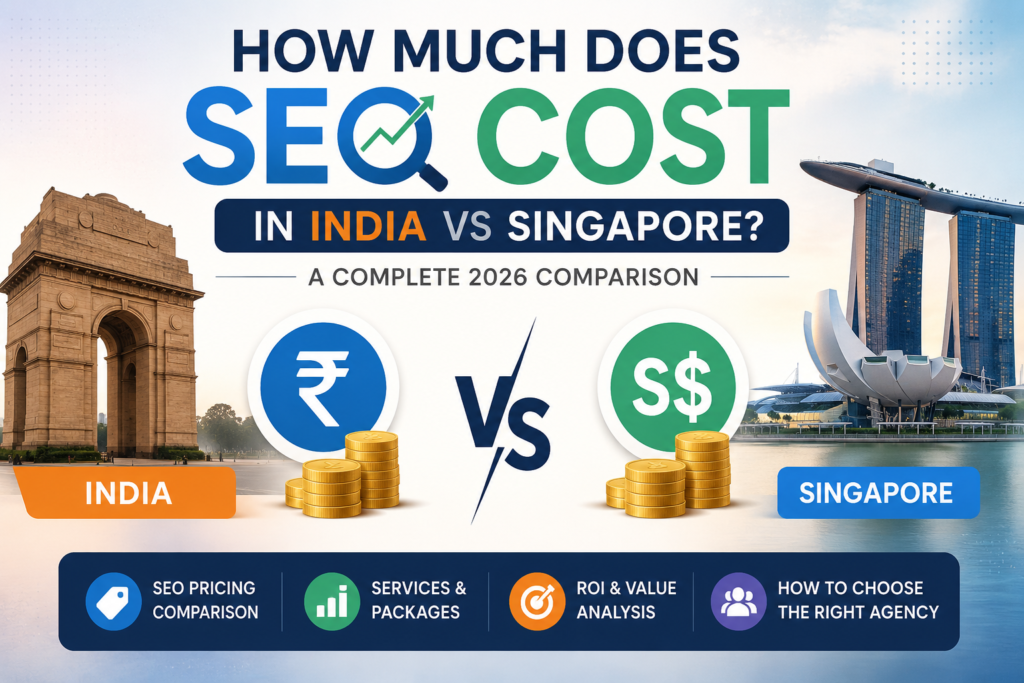
Comparison of SEO costs in India vs Singapore for 2026, featuring India Gate and Singapore's Marina Bay Sands skyline, currency symbols, pricing comparison elements, and digital marketing graphics highlighting SEO packages, ROI, and agency selection.
SEO

SEO Costs Compared: India vs Singapore in 2026

Search Engine Optimization (SEO) remains one of the most effective digital marketing strategies for businesses looking to increase online visibility, generate leads, and drive long-term growth. However, one of the most common questions business owners ask is: “How much does SEO cost?” In this comprehensive 2026 comparison, we’ll explore SEO costs in India and Singapore, the factors that influence pricing, and how to choose the right SEO partner for your business. Why SEO Pricing Varies SEO is not a one-size-fits-all service. Several factors influence the cost of an SEO campaign: Industry competition Target keywords Geographic location Website size and complexity Technical SEO requirements Content creation needs Link-building efforts Agency expertise and experience Businesses targeting highly competitive industries such as finance, healthcare, legal services, and e-commerce typically require larger SEO investments than local service providers. Average SEO Costs in India (2026) India has become a global hub for digital marketing services, offering high-quality SEO solutions at competitive prices. Monthly SEO Packages Service Level Monthly Cost (INR) Basic Local SEO ₹10,000 – ₹25,000 Small Business SEO ₹25,000 – ₹50,000 Medium Business SEO ₹50,000 – ₹1,00,000 Enterprise SEO ₹1,00,000 – ₹5,00,000+ One-Time SEO Services SEO Audit: ₹10,000 – ₹50,000 Website Optimization: ₹20,000 – ₹1,00,000 Content Optimization: ₹5,000 – ₹20,000 per page Link Building Campaigns: ₹15,000+ per month Benefits of Hiring an SEO Agency in India Cost-effective services Access to experienced SEO professionals Flexible pricing models Strong technical SEO expertise High-quality content creation at competitive rates For businesses seeking quality SEO services without a large marketing budget, India remains one of the most attractive options globally. Average SEO Costs in Singapore (2026) Singapore has a mature digital economy and a highly competitive online marketplace. As a result, SEO services are generally more expensive compared to India. Monthly SEO Packages Service Level Monthly Cost (SGD) Local SEO SGD 500 – SGD 1,500 Small Business SEO SGD 1,500 – SGD 3,000 Competitive SEO Campaigns SGD 3,000 – SGD 8,000 Enterprise SEO SGD 8,000 – SGD 20,000+ One-Time SEO Services SEO Audit: SGD 500 – SGD 3,000 Technical SEO Fixes: SGD 1,000 – SGD 10,000+ Website Optimization: SGD 1,500 – SGD 15,000 Content Strategy Development: SGD 1,000+ Benefits of Hiring an SEO Agency in Singapore Strong understanding of local market trends Expertise in Singapore-specific search behavior Local language and audience targeting Better alignment with Singapore regulations and business practices India vs Singapore SEO Pricing Comparison Factor India Singapore Average Monthly SEO Cost ₹25,000 – ₹1,00,000 SGD 1,500 – SGD 8,000 Local SEO Cost Lower Higher Technical SEO Cost-effective Premium pricing Content Creation Affordable More expensive Link Building Competitive pricing Higher costs ROI Potential Excellent Excellent The biggest difference lies in labor and operational costs. Singapore agencies typically have higher overhead expenses, which are reflected in their pricing. Choose an Indian SEO Agency If: You want cost-effective SEO solutions. You have a limited marketing budget. You need comprehensive SEO services at competitive rates. You want to scale SEO efforts without significantly increasing costs. Choose a Singapore SEO Agency If: Your primary audience is based in Singapore. You need deep local market expertise. Face-to-face collaboration is important. You require highly localized marketing strategies. The Hybrid Approach: Best of Both Worlds Many businesses today are adopting a hybrid strategy by partnering with agencies that understand both markets. For example, companies targeting Singapore customers can benefit from the affordability and technical expertise of Indian SEO teams while implementing strategies tailored specifically for Singapore audiences. This approach often delivers better ROI without sacrificing quality. Hidden Costs Businesses Should Watch Out For When comparing SEO proposals, don’t focus solely on price. Consider whether the package includes: Technical SEO Content creation Keyword research Competitor analysis Link building Monthly reporting Google Business Profile optimization Conversion rate optimization Low-cost SEO packages may exclude critical services, resulting in slower growth and reduced ROI. How to Choose the Right SEO Agency Before hiring an SEO agency, ask the following questions: Can you provide case studies? What industries have you worked with? How do you measure SEO success? What tools do you use? Do you follow Google’s SEO guidelines? What is included in your monthly package? How often will I receive reports? A reliable SEO partner should focus on sustainable growth rather than quick rankings. Why Businesses Trust FirstRankology At FirstRankology, we help businesses in both India and Singapore improve their online visibility through data-driven SEO strategies. Our services include: Technical SEO Local SEO Keyword Research Content Optimization Link Building SEO Audits Performance Tracking Whether you’re a startup, SME, or established enterprise, our team develops customized SEO strategies designed to generate measurable business results. Rather than choosing the cheapest option, focus on finding an agency that delivers transparent reporting, proven results, and long-term value. The right SEO partner can become one of the most powerful growth drivers for your business in 2026 and beyond.  

DMCA.com Protection Status
Scroll to Top